
Cours de coréen ᚛ Level 1 - My First Steps in Korean (Lessons 1 to 30) ᚛ Leçon 7 - Liaison in Korean
Liaison in Korean
Classic liaison
In some languages, a liaison happens when a word ends with a consonant and is followed by a word that begins with a vowel. In making the liaison, the consonant is pronounced and becomes part of the following word.
Remember that in Korean, consonants are not always pronounced the same depending on whether they are at the beginning or the end of a syllable, so you have to adapt! A liaison is created when a syllable ends with a consonant and the following syllable begins with a vowel sound, i.e. the silent consonant ㅇ.
한국어 (= Korean language) is composed of:
- 한
- 국
- 어
However, 국 which ends with ㄱ and 어 which begins with ㅇ follow each other, so there is a liaison. Imagine the word as if ㄱ became the initial consonant of the following syllable.
In our mind, we could imagine this: [한구거].
- 한
- 구
- 거
한국어
먹었어 (= I ate) is composed of:
- 먹
- 었
- 어
But beware, there are two liaisons here!
Between 먹 and 었, a liaison occurs and you should imagine that ㄱ becomes the initial consonant of 었.
Equally between 었 and 어, another liaison occurs and you should imagine that ㅆ becomes the initial consonant of 어.
We can then imagine the word 먹었어 as follows: [머거써].
- 머
- 거
- 써
먹었어
Liaison with compound consonants
En savoir +
Liaison with a space
Be careful, if a space is present between two syllables, the liaison may be different.
En savoir +
Exercices
En savoir +
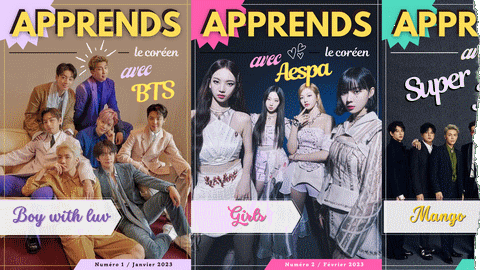
Apprends le coréen avec la K-pop est un ensemble de 4 numéros qui permettent d'apprendre de nombreux points de la langue coréenne en se basant sur des chansons coréennes récentes. Pourquoi apprendre le coréen avec des chansons ?
- Pour apprendre du vocabulaire et des expressions dans l'air du temps, utiles dans la vie quotidienne
- Pour pouvoir travailler la prononciation du coréen à l'aide de la chanson étudiée
- Pour voir ou revoir de nombreux points de grammaire disséminés dans les couplets
- Pour s'amuser tout en apprenant des choses, car quoi de plus ludique que nos chansons préférées ?