
Cours de coréen ᚛ Level 3 - Korean for Beginners #2 (Lessons 61 to 90) ᚛ Leçon 67 - The plural in Korean [들]
The plural in Korean [들]
The plural in Korean
In the beginning chapters we saw that, in Korean, the notion of singular and plural does not exist.
That means that the word 고양이 could very well designate a single cat or many cats, depending on the context.
However, there are definitely circumstances where one wants to specify that there are several entities being talked about and not just a single one, in order to avoid ambiguity. In addition, it's common to mark the plural with something "in general", like "Koreans in general" or "cats in general", when speaking.
To mark the plural, one simply adds the particle 들 after a countable noun, in the following way:
[Nom]들
- 아이 (= the child) → 아이들 (= the children)
- 한국 사람 (= the Korean person) → 한국 사람들 (= the Korean people)
- 친구 (= the friend) → 친구들 (= the friends)
그 친구들은 우리 집에 있어요.
→ Those friends are at my place.
그 카페에 사람들이 많이 있었어요.
→ There were a lot of people in that cafe.
By the way, we already saw the particle 들 when we studied plural personal pronouns.
다행히 그들은 모두 무사해요.
→ Fortunately, they are all safe.
Everyday situations
In everyday phrases, marking the plural is often pointless since one can guess if one or several things are being talked about from the context.
If you're at the market and you say:
그 사과 좀 주세요.
→ Give me this apple, please. / Give me these apples, please.
There's no point in indicating the plural. Basically, if you indicate a single apple with a finger, the vendor will understand that you want that specific apple. If you point to a small box with six apples, the vendor will understand that you are asking for the six apples. Even so, it is still possible to say with precision the number of apples you want.
Ambiguous situations
En savoir +
Emphasis with 들
En savoir +
Exercises
En savoir +
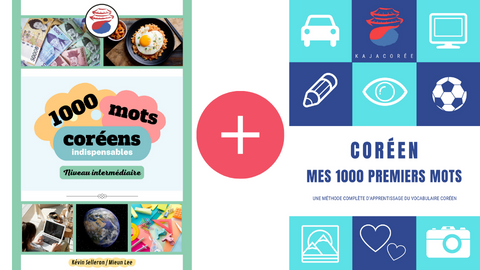
2000 mots coréens essentiels est un pack qui contient les deux produits suivants :
L’ensemble de ces deux livres de vocabulaire coréen représente plus de 2000 mots essentiels répartis en 82 catégories. Tous ces mots sont accompagnés de leur prononciation audio réalisée par des Coréens natifs.
De plus, un outil en ligne d’apprentissage du vocabulaire basé sur la méthode scientifique de Leitner par répétition espacée, la plus puissante à ce jour pour mémoriser le vocabulaire, est inclus. Cet outil vous permet, chaque jour, de vous entraîner au vocabulaire en vous faisant réviser les mots du livre. Il calcule ensuite automatiquement à quel moment vous devez le réviser de nouveau afin qu’il s’ancre petit-à-petit dans votre mémoire long terme et que vous ne l’oubliiez plus jamais.
En savoir +